Postpartum Planning: What Nobody Tells You Before Baby Arrives (And Why It Matters)

|
If you're pregnant and already thinking about what comes after the birth, you're ahead of most parents. Keep reading. This one is for you. |
You have the birth plan. You've toured the hospital. You've compared every infant car seat on the market and probably Googled the same question six different ways just to be sure.
And postpartum planning? It's still on the list, somewhere near the bottom.
I get it. The birth has a date. It has a finish line. Postpartum feels abstract, something to figure out when you get there.
But here's what I've seen over and over again in my work as a postpartum doula serving Holly Springs, Fuquay Varina, Cary, Apex, Raleigh, and surrounding areas. The parents who don't plan for what comes after the birth are almost always the ones who feel most blindsided when it arrives.
This post is for you before the baby gets here.
I Learned This the Hard Way
In 2006, I became a parent in the middle of one of the hardest seasons of my life.
My husband was critically ill. I was running on empty before my son even arrived. And when he did, I went straight into survival mode. I didn't rest. I didn't slow down. I didn't ask for help in any real way because I didn't even know what kind of help to ask for.
What I needed, and didn't have, was someone to come alongside me. Not to take over. Not to tell me what to do. Just someone to sit with me in it, watch me with my baby, and say: you are doing good work. This is hard work. Both things are true. Someone to speak life into me when I didn't have anything left.
I didn't have that mentor. I didn't have that guide. And honestly, I was so used to going fast that I didn't even realize slowing down was a skill. That would take years to learn.
It's a big part of why I became a postpartum doula. Because I lived the version of early parenthood where you white-knuckle through it alone, and I wanted something different for the families I work with.
What I wish I had known then is what I'm sharing with you now.
Why Most Parents Don't Plan for Postpartum
There's a skewed picture most of us carry into early parenthood. We know babies are a lot of work. We've heard the sleep deprivation jokes. But nothing quite prepares you for the reality of caring for a newborn.
A baby who feeds 8 to 12 times a day. Short stretches of sleep that are biologically normal but completely different from the adulting life you've been living. A body that just did something enormous. A relationship that now has a third person in it, around the clock.
The biggest objection I hear from parents when I bring up postpartum planning is some version of: we'll figure it out. And I believe them. They will figure it out. But figuring it out in the middle of sleep deprivation, with a newborn in your arms and a relationship under strain, is so much harder than having the conversations ahead of time.
Research from the Gottman Institute found that nearly two-thirds of couples report a significant decline in relationship satisfaction in the first three years after having a baby. Learn more here.
Two-thirds.
That's not a rare experience. That's the majority of new parents, overwhelmed, running on empty, and not having had the conversations they needed to have before baby arrived.
The conversations about expectations. About feeding, sleeping. About who does what when both of you are depleted.
That's exactly what a postpartum planning session is for.
A Tradition We Quietly Abandoned
Cultures around the world have long honored the postpartum period as a time set apart.
In China, it's called zuo yuezi, sitting the month. In Latin America, la cuarentena, forty days for rest and restoration. In many parts of Africa, Southeast Asia, and the Middle East, there are similar traditions. A protected window after birth where the new parent slows way down, receives care, bonds with the baby, and heals.
We don't have that in our culture. We tend to push parents back into normal life far too quickly. And we pay for it.
The book The First Forty Days by Heng Ou is a beautiful resource on this. I talked about it with Stephanie Gleason, a postpartum doula from Au Petit Jour, when she joined me on the podcast to talk about nourishment after birth and what it actually looks like to care for yourself in the fourth trimester. And Lauren Mages from Mind and Body Vitality and I also touched on this when we explored whole body wellness in the postpartum season, including how movement and nourishment during this period set the foundation for so much more.
Both conversations kept coming back to the same thing. Slowing down isn't a luxury. It's how you actually recover.

But I also know 40 days feels like a big ask. Life doesn't pause. Work doesn't pause. Other kids don't pause.
So if the first 40 days feel overwhelming right now, here's a gentler place to start.
The 555 Rule: A Practical First Step
The 555 rule is one of the most accessible frameworks I share with parents who are preparing for the postpartum season. It's simple. It's flexible. And it gives you something most new parents don't give themselves: permission.
Here's how it works.
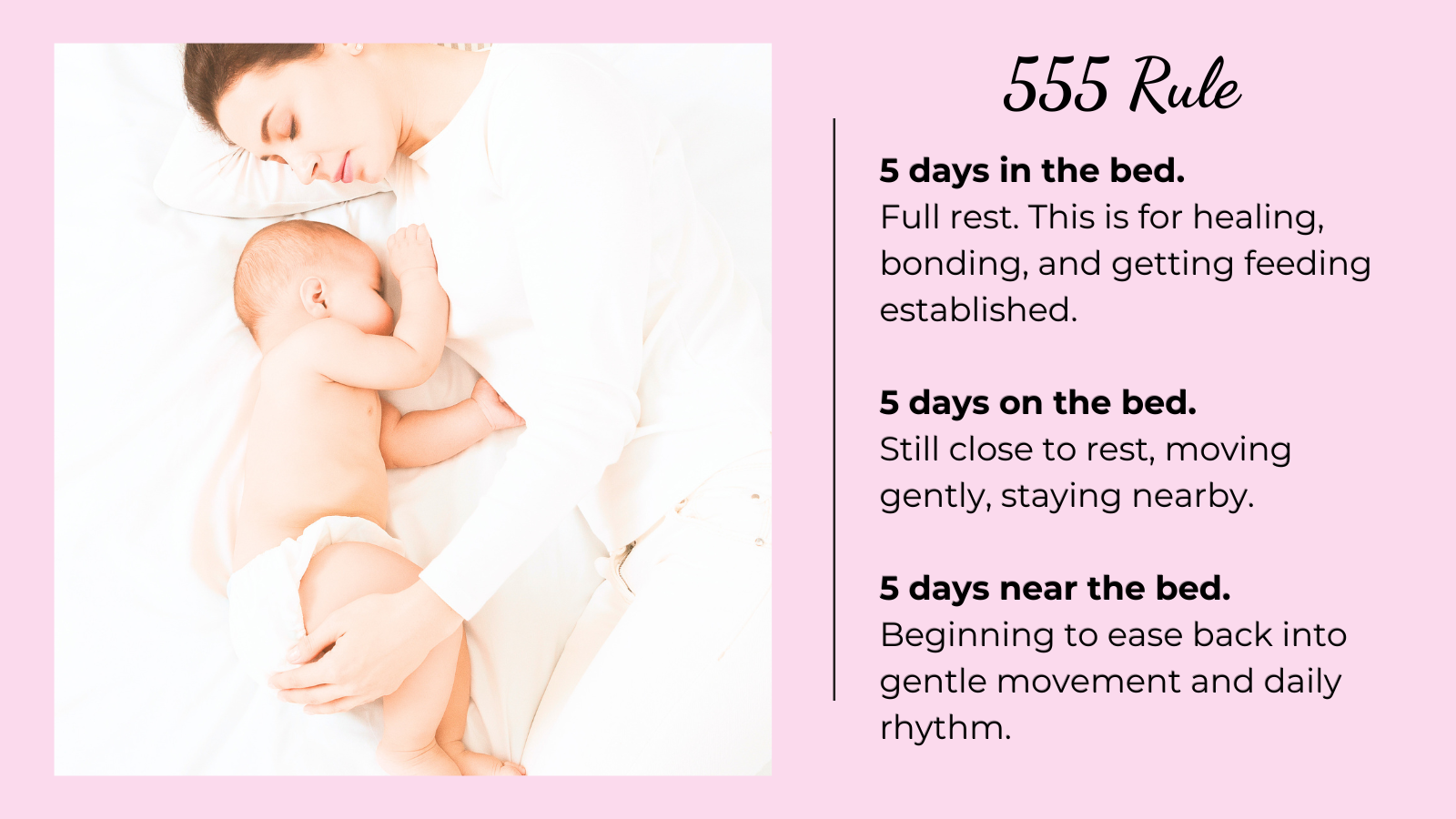
That's roughly two weeks. And here's why each part matters.
In the bed is your recovery window. Your body just did something enormous. Whether you had a vaginal birth or a cesarean, you need real rest. Not the kind where you're scrolling your phone and answering messages. Real rest. This is also the most critical window for getting feeding established, for skin-to-skin contact, and for beginning to learn your baby's cues. The world can wait. This cannot.
On the bed is your bonding phase. You're still resting, but you're beginning to move a little more gently. Sitting up. Short trips and back. Letting visitors come to you rather than the other way around. You and your baby are getting to know each other. Their sounds, their rhythms, what they need and when. That work takes presence. Protect it.
Near the bed is where you start finding your footing. Gentle movement. Short walks. Beginning to ease back into daily rhythm as a family. But still close. Still slow. Still recovering.
Our culture doesn't honor this. We celebrate the parent who bounced back quickly. We ask "how's the baby?" before we ask "how are you?" We send meals for a few days and then disappear. And then we wonder why so many parents hit a wall at six weeks.
Your body needs time to recover. Your baby needs you to be present. And you both need the kind of quiet, unhurried time together that simply isn't possible when you're trying to be back to normal before you're ready.
I didn't do this in 2006. I didn't know it existed. And even if someone had handed me a plan, I'm not sure I would have taken it. I was so used to moving fast that stopping felt impossible. Slowing down was a skill I hadn't learned yet.
|
But if someone had told me about this, it would have given me permission to pause. That's what I want to give you now, before you need it, while you still have the capacity to receive it. |
What Postpartum Planning Actually Covers
A postpartum planning session is about having the important conversations before you're too depleted to have them well.
In a session together, we walk through:
- Expectations and arrangements. What does a typical day look like? Who handles what? What does support from family actually look like, and how do you ask for it in a way that works for your family?
- Feeding and sleeping. Whether you're planning to breastfeed, pump, formula feed, or some combination, this is one of the most important things to think through ahead of time. Getting feeding established in the first 6 to 8 weeks is one of the most powerful ways to lay a healthy sleep foundation. You can learn more about what newborn sleep actually looks like in this post on the fourth trimester.
- Food and hydration. Who is making meals? What do you actually need to nourish a healing body? This matters more than most parents anticipate.
- Self-care habits to begin before baby arrives. This isn't about bubble baths. It's about practicing the skills you'll need most. Breathing. Slowing down. The mindset moments I build into everything I teach and coach, noticing what your body needs, pausing before you react, coming back to yourself when everything feels like too much. These aren't extras. They're the foundation. Start building them now.
- Roles and responsibilities. Clear expectations reduce resentment. This is one of the most underrated conversations to have as a couple before baby arrives.
- Postpartum mental health support. What does it look like if you're struggling? Who do you call? What's the plan before you need it?
This guide also becomes something you return to. At six months. At a year. During big transitions. Whenever the family system needs a reset and a review of who's doing what and why.
➡️ You can learn more and access the Postpartum Planning Guide here.

What to Have Ready: Your Postpartum Essentials
One of the most practical things you can do right now is get your recovery supplies together before baby arrives. You will not want to think about this in those early days.
Postpartum Bathroom Essentials
- Angled Peri bottle
- Witch hazel pads-Tucks
- Sitz bath
- Sitz bath soak
- Hemroid Salve
- Perineal foam or spray or balm
- Instant Ice Pads
- Comfortable, high-waisted postpartum underwear
- Uterine Reusable Hot and Cold Pack
- Overnight pads
- Dermaplast
- Stool softener (ask your care team)
- A small basket or cart to keep everything within reach
Postpartum Recovery Cart
Keep this stocked and mobile. Bring it with you wherever you're resting.
- Water bottle you actually love using
- Snacks that don't require two hands (granola bars, nuts, lactation cookies)
- Nip & Lip Balm for you and baby
- Nipple cream
- Nursing pads
- Lily Pads- Reusable Silicone
- Phone charger with a long cord
- Earbuds
- Burp cloths
- Something for you, not just the baby
The goal is to make it easy to care for yourself without getting up and searching. Everything you need, right where you are.
➡️ Here are a few of my other Favorite Things.

Where I Come In
As a postpartum doula serving Holly Springs, Fuquay Varina, Cary, Apex, Raleigh, and surrounding areas, this is the work I love most.
Getting to be present in those early weeks. Helping families learn their baby. Supporting feeding. Helping everyone get a little more rest. And maybe most importantly, being the person who looks a new parent in the eye and says: you are doing good work. This is hard work. You are not failing.
What most parents don't realize is that establishing feeding well in the first 6 to 8 weeks is one of the most important things you can do for your baby's long-term sleep. Sleep looks very different in the fourth trimester, and it's supposed to. When you understand what's normal and what to expect, the overwhelm starts to loosen a little.

Before You Go
I want to ask you something.
What would it mean to arrive in those first weeks with a real plan? Not a perfect one. Just a thought-through one.
The birth is important. So is what comes after it. And the families who do the planning work before baby arrives almost always tell me the same thing afterward: I'm so glad we did that.
If you're ready to have those conversations, the Postpartum Planning Guide is a good place to start. And if you want in-person postpartum doula support in the Holly Springs, Fuquay Varina, Cary, Apex, or Raleigh area, I'd love to connect.