Why Your Child Can't Sleep: Nervous System Signs Parents Miss
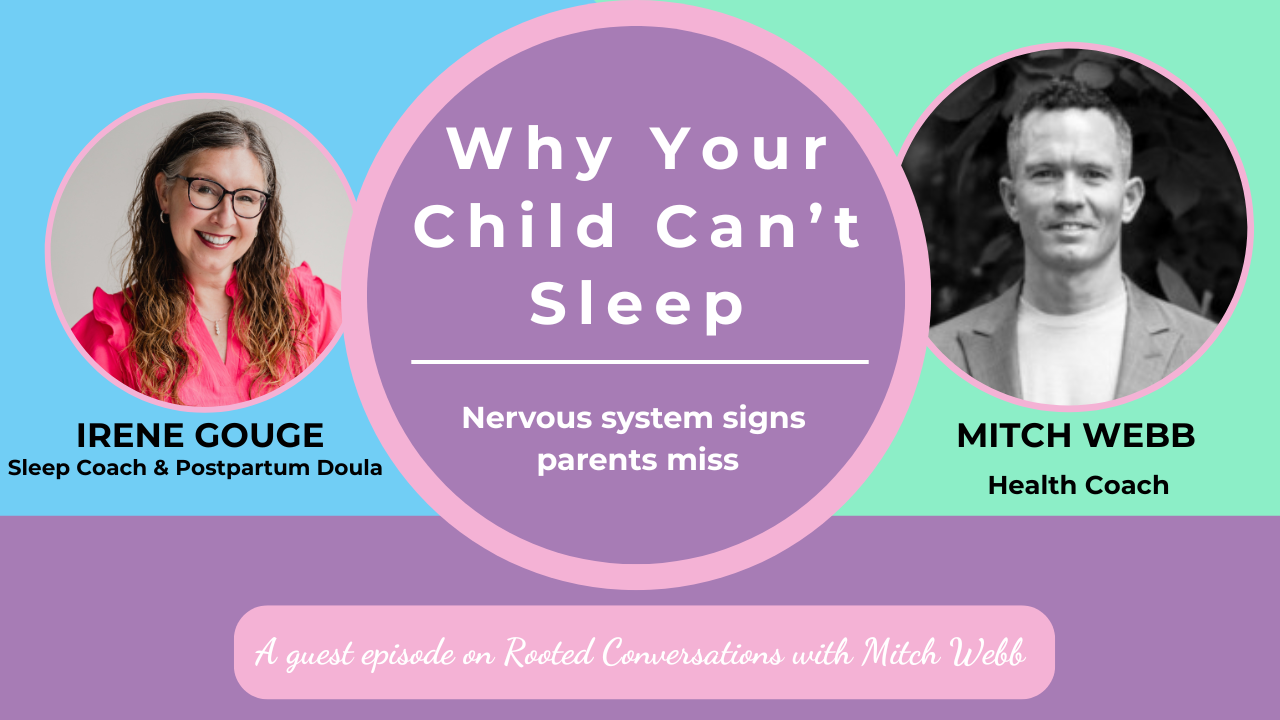
I was recently a guest on Rooted Conversations with Mitch Webb, and it turned into one of those conversations I keep coming back to.
Mitch works with adults around nervous system regulation. What made our time together so rich is that we were looking at the same thing from two different angles. I was sharing how sleep works for children — the biology, the behavior, the relationship, and Mitch was connecting it back to what adults experience in their own bodies. Same nervous system. Same deep need for safety. Different season of life.
If your baby is fighting sleep, your toddler keeps waking up at night, or bedtime has turned into a battle you dread...I want you to listen to this episode. Because the answer is rarely what it looks like on the surface.
Why Is My Child Still Not Sleeping No Matter What I Try?
Here's something I come back to again and again in my work as a family sleep coach: lack of sleep is a symptom. There is always a root cause.
One of the most important root causes we explored in this conversation is the nervous system. Before a child can fall asleep, the nervous system has to feel safe enough to actually let go. Sleep requires a real release of control. And a body that doesn't register safety simply won't do it, no matter how beautiful the bedtime routine is.
This is not willfulness. This is not your child being difficult. This is biology. And once you understand that, everything about how you approach bedtime starts to shift.
What Are the Signs My Child's Nervous System Is Struggling at Bedtime?
Early in our conversation, we dug into this, and I'd encourage you to really pay attention here, because these signals are easy to misread as behavioral problems.
Watch for:
🟣 Bedtime resistance that escalates into big emotions or a power struggle — not just "I don't want to go to bed" but flooding, clinging, or shutting down completely. You might also notice your child won't let you put them down unless you rock, hold, bounce, or lie right next to them.
🟣 Waking frequently after 3 AM — this is actually light active REM sleep where children are processing emotions. More light active sleep in the early morning hours is completely normal for children, it is not a behavior issue. It is simply where a lot of emotional work is happening in the body as it restores, refreshes, repairs, and rejuvenates.
🟣 Repeated reassurance-seeking at night — needing you there, asking if they're safe, calling out again and again. When you see this pattern, it's worth looking at the whole day. Children need connection, and when the day has been rushed or disconnected, they look for it at night.
🟣 Hyperalert at bedtime — scanning the room, startling easily, not settling even when everything looks calm. Some children are naturally more sensitive, more alert, or have serious FOMO. They notice every detail. You simply cannot trick them to sleep, and honestly, that's a sign of a bright, aware child so they notice any changes you introduce.
These are nervous system signals. And the good news is that nervous system states are changeable, especially with connection and the right environment.
Why Dreading Bedtime Makes It Harder for Your Child to Sleep
Early in our conversation, Mitch and I talked about something that I want every parent to hear — gently, because this is not about blame.
Your nervous system and your child's are in constant communication. It's called co-regulation. What that means practically is that when you walk into the bedroom rushed, tense, or emotionally flooded, your child's body picks that up before a single word is spoken.
This is why I always start with the parent first. Not because you are the problem, but because you are the most powerful tool in your child's sleep environment.
The Breathe LOVE Framework
This is the heart of the work I bring into every family I support. It starts with B — Breathe.
Before we talk about listening, observing, or any of it, the first step is to Pause. Take a breath. Shift yourself from reacting to consciously choosing to respond. That one breath is the difference between escalating the moment and leading through it.
💜 B — Breathe: Pause before you enter the room. One intentional breath shifts you from reacting to responding.
💜 L — Listen: What is your child actually communicating? And what is your own body telling you in this moment?
💜 O — Observe: Without rushing to fix or react. Just notice what is happening. Ask yourself a better question.
💜 V — Validate: Your child's experience is real. So is yours. Both can be true at once.
💜 E — Empower: Lead with calm and confidence. You know your child. Trust that.
When you can Breathe LOVE into bedtime, the whole experience shifts. Your child feels it. Their nervous system responds to yours. And that opens the door for sleep in a way that no method alone ever can.
👉 Grab the free Breathe LOVE Guide
How Do YES Spaces Help Children Feel Safe Enough to Sleep?
One of the things I got to share in this conversation was the concept of YES Spaces, and it fits so naturally into a nervous system discussion.
Mitch talked about orienting — the process adults go through to scan their environment and register whether it is safe before they can relax. Children do the same thing, but they can't always do it on their own yet. They need us to help create that safe environment for them. A space — and a relationship — that already communicates: you belong here, you are safe here.
A YES Space is an intentional environment where a child can explore, play, and simply be during their wake windows, without constant correction or intervention. It becomes a daily, predictable rhythm that your child actually looks forward to. They know they are going to do their work — and play is their work — and they can enjoy that time fully because they feel safe, confident, and trusted.
This daily practice of separation during a wakeful window makes the transition into the sleep window so much smoother. It's not a big deal for your child because they've already spent time being okay on their own — happily. And this isn't just for infants and toddlers. Preschoolers and older children benefit just as much. Learning to use their time, entertain themselves, and tap into their own creativity builds the kind of confidence and independence that makes bedtime feel like a natural next step — not a threat.
That security carries directly over into sleep.
👉 Read & Listen to: Ep. 25: The Power of YES Spaces — Simplify Parenting, Improve Sleep
Why Does a Consistent Bedtime Routine Actually Work?
As we got deeper into the conversation, we talked about why consistency at bedtime matters, and it goes so much deeper than just habit.
A consistent bedtime routine doesn't just help kids know what's coming next. It actually trains the nervous system. When the same cues happen in the same order night after night, the body begins to associate those cues with safety and rest. This is a biological response, not just a behavioral one. The nervous system learns: this is what safe feels like right before sleep.
And it's not just the routine itself, consistent wake times and bedtimes matter too. When the body can predict when sleep and waking are coming, it begins to regulate naturally. Your child's internal clock starts working with you instead of against you. This is one of the reasons I talk about anchor times — a consistent time to wake and a consistent time to wind down — as the foundation on which everything else is built on.
This is why I talk about flexible routines rather than rigid schedules. The consistency lives in the cues — the connection, the predictability, the relationship — not in stressing about hitting the same clock time every night. When children can genuinely predict what is coming, when the environment and the people in it feel trustworthy, the nervous system can finally let go.
What Can I Do During My Day to Help My Child Settle at Bedtime?
We also talked about some of the calming techniques I use with families — and what I loved is that Mitch could speak to how these same tools translate for adults too.
A few to weave into your day:
✅ Breathe together — slow, intentional breaths with your child, not just telling them to calm down. Do it with them. Your regulated breath is contagious to download your calm.
✅ Take a grounding walk — step outside for even 2–3 minutes. Take your shoes off and walk barefoot. Let your feet touch the grass. Notice the fresh air and the light. Letting your feet connect with the ground helps shift the energy in your body and brings your nervous system back to a calmer state. You don't need a lot of time. You just need to do it.
✅ Think through your daily rhythms and routines ahead of time — decision fatigue is real, and it builds up throughout the day. When you make decisions in advance — what does mealtime look like, sound like, and feel like? Where does it happen? What comes next? You free yourself up to simply lead your child through the routine with ease instead of figuring it out on the fly while everyone is tired and hungry.
These daily mindset moments and brain breaks aren't extras; they are how we regulate ourselves throughout the day so that bedtime feels calmer for our children and for us. This is what we work on together when we do sleep coaching work.
Your Sleep Matters Too
Something I appreciated about this conversation is that Mitch works with adults — so we naturally touched on how these same nervous system principles apply to parents as well. Toward the end of the episode, we talked about tools to ease nighttime anxiety for grown-ups too.
Sleep deprivation affects more than your energy. It affects your regulation, your patience, and your ability to show up calm and confident for your family. You cannot pour from an empty cup, and I mean that not as a cliché but as a real, lived truth. I was there.
You deserve rest, too. Your sleep is not a luxury. It is the foundation on which everything else is built on.
Key Loving Lessons Learned in This Episode
🟣 Lack of sleep is a symptom — there is always a root cause. Often, it is the nervous system and understanding how our communication impacts our children and ourselves.
🟣 A child's body has to register safety before it can release into sleep.
🟣 Your nervous system co-regulates with your child's; your calm is the most powerful bedtime tool you have.
🟣 Breathe LOVE — start by breathing first, pausing before you react, then Listen, Observe, Validate, and Empower.
🟣 YES Spaces build a child's sense of safety and independence during the day, which carries directly into better sleep at night.
🟣 Waking frequently after 3 AM is normal light active REM sleep where children are naturally in a light state of sleep — understanding this changes how you respond.
🟣 Consistent wake times, bedtimes, and sleep cues train the nervous system — it goes deeper than just routine.
🟣 Daily brain breaks and mindset moments — grounding walks, breathing, predictable rhythms — regulate you and your child throughout the day, not just at bedtime.
🟣 Your sleep matters too — it is the foundation everything else is built on.
Resources Mentioned to Help You Keep Learning & Growing
⭐ Ep. 25: The Power of YES Spaces — Simplify Parenting, Improve Sleep
⭐ Ep. 28: From Chaos to Calm — Light Active REM Sleep
⭐ Mitch Webb's Free Nervous System State Quiz
⭐ Connect with Mitch: mitchwebb.com | Instagram: @kmitchwebb | Facebook: Mitch Webb
|
Ready to get to the root of your child's sleep challenges? If you've been adjusting the routine, shifting the schedule, trying everything — and it's still not working — you are not missing something obvious. You may just need to go a little deeper. That is exactly what I help families do. Ready to help your child settle, sleep soundly, and wake up rested with a flexible routine that actually works for your family? 📞 Set up your FREE 15-minute phone call. |
Connect with me! Instagram | YouTube | Facebook | Pinterest
Subscribe to the Podcast:
ppp on Apple Podcasts Listen on YouTube Listen on Spotify
Learn about Mitch and other Trusted Professionals here on the Referral Directory
Disclaimer: Transcripts were generated automatically and may contain inaccuracies.
Podcast: Rooted Conversations Host: Mitch Webb Episode Title: Why Your Child Can't Sleep: Nervous System Signs Parents Miss All right, guys, welcome to the Rooted Conversations podcast. I am your host, Mitch Webb. Today we have a very special guest, Miss Irene Goose. She's from one of my local holistic practitioner groups here in Holly Springs, NC, close to Raleigh, NC, and she is a postpartum doula and sleep coach. So I know that a lot of the clients that I'm working with are dealing with nervousness and dysregulation, are dealing with sleep issues. And when I heard that she's a sleep coach, I want to get her in. She specializes in helping babies who are having trouble sleeping or helping the parents of the children that are having trouble sleeping. And what she was telling me offline is that she ends up helping the parents a lot. And she's already given me all types of cool information and tips. I had to hit record before we talked for an entire 3 hours before we got on here. So Irene, welcome to the podcast. I'm so excited to have you here. Speaker 2 Thank you, Mitch. I'm really excited to connect and talk about nervous system stuff. I love geeking out on this. Speaker 1 Oh, yeah. Oh, yeah. I mean, I feel like nervous system regulation and sleep goes hand in hand. And I for me, I had insomnia for for 20 years. I still deal with insomnia here and there. It's gotten so much better because of the nervous system work. And kind of like we were talking about offline, there's so much information when it comes to sleep and there's biohacking and all of these things that can really sounds good on the surface, but can kind of keep keep us in a pattern of not sleeping and trying to fix something that's not broken. So I'm glad you're here to kind of clear that up. But to get started, you know, there's got to be a back story of someone who becomes a sleep coach. Like, were you a lifetime sleep expert or was there a time when sleep was tough? You know, how did you get into this work? Speaker 2 Yeah, so my work was inspired 19 years ago by my oldest son, who was not sleeping. And there were so many aha moments that happened for me years later. But of course, hindsight is 2020 always. But when he was born, I didn't know or understand anything about newborn sleep. And he was like, grunting, doing all this stuff. And I didn't realize at the time that that was actually sleep communication. And now sleep communication, like grunts and kicking and things like that, that the body does that is doing while they're sleeping. And because babies actually have a lot of active sleep, they spend over 50% of their time in active sleep. And I think as adults, we don't really understand active sleep and deep sleep and really understanding what that looks like and feels like. And so it can be really confusing. Well, here's my son Grunton doing all his things. Then I'm walking, doing miles in my house. And the moment I would try to put him down, he'd pop up. And one of the things I realized I was like, I never coached him or taught him, like to learn to accept his sleep environment. So then I was just like rocking and doing all the things for him. And you know what, babies actually need that. Like babies need to learn what it is to be soothed and to be regulated. How parent stress affects your child’s sleep The challenging part was that I was not regulated and so and I didn't know that I was dealing with intrusive thoughts at the time. My husband had a pretty major surgery right around his birth. And so like that whole first, I would say year for my son Connor was a blur. And I didn't know like that the way I was showing up and taking care of everyone around me but myself was really the impact of keeping me sleepless. And I had all these anxious thoughts. So even if and when he was sleeping, I was waking up in the middle of the night. I mean, it was just a nightmare. So that's kind of how it felt when I became a parent. And then I was a school teacher and I was like, well, what can I do to get out of the classroom but still be teaching? And so I got trained as a sleep coach with the sleep lady. And I was part of her first 50 cohort members. And it was just amazing. And I learned so many things about the body. And it was like the beginning of like my healing journey of recognizing like that I was probably dealing with postpartum depression and anxiety. I didn't have a support system. I didn't know and understand what was happening in my body and how to take care of myself as I was trying to take care of my little one. Speaker 1 That's such a an interesting correlation between what I see so much. I mean I feel like nervous system regulation and sleep. Like I already think I already said that it goes hand in hand. But talking about you being dysregulated as the parent, not understanding the accepting the sleep environment, understanding our intrusive thoughts, how our dysregulation is affecting others. And really, I think it's amazing to recognize that it takes a lot of awareness to, to slow down and see that and then to want to attune and, and learn how to help someone else. Because you know that we know that we help our family, our kids, our friends and people that we love, that that ripples out. I want to circle back and understand what does it mean to accept our sleep environment. The role of safety in falling asleep Accept our sleep environment, like so your body is all about having a safe sleep or like a safe safety check, right? So most of us don't realize that the first thing our body is scanning for a safety and security. Sure. And so if I don't know what that environment looks like, so you just drop a baby in a bassinet or put them in a pack and play or lay them down somewhere. They're like, what? I'm not in my mom or dad's cozy arms, like no one's holding me. I don't know and understand what that feels like. So it's important to think about how do I practice that with my child? For example, I also work with toddlers and preschoolers. So sometimes we want them to sleep in A room by themselves, but they've never had a chance to practice what it felt like to actually be by myself and feel safe in an environment. And so oftentimes, I encourage parents to think, I don't know if you've ever heard of like a yes space. Speaker 1 Tell me, I mean, I, I can, I can think of so many I think of immediately when you say accept the environment of I just went on vacation. That first night of sleep, half of your brain is awake and trying to figure out what's going on. Is that similar to a child that hasn't slept on their own? Would that be like a correlative deal? Speaker 2 Think about when you went on vacation, did you go around the room, like check the bed, go to the bathroom, look around? Speaker 1 So that's what I want to know next, like what are the things that we can do? Like if someone's listening to this, I am all about accepting, right? Accepting our sensations, our symptoms, all of that. One of the most compactful things that I've done for my nervous system this year. How do we accept a sleep environment? If you know, if you want to go into our bedroom tonight and do that. Speaker 2 Yeah, so, so think about it like you go to a hotel for traveling. You look in your environment, you're checking everything out. You're actually allowing your body to assimilate and become like aware of the environment and be like, hey, this is OK, this is safe for you to let go and drift off to sleep because biologically that's what happens with sleep. Like you drift off and let go because your body feels safe and secure. The challenging part is, let's say you're a child and you've never had an opportunity to practice that and you just travel and you're expected to just sleep in a pack and play that. Speaker 1 Sounds like pressure to me. Speaker 2 That's a lot of pressure. And so now all of a sudden, my body's on alert. I'm like, oh, no, that's not going to happen. So like, literally what would happen is I would walk through the door. My son was very alert and very aware, and I never practiced with him, like what it looked like to just be in that room. We changed his diaper. We went to sleep in there. But like, did I actually take time to play and like, let him like take in his environment what he was actually seeing? And so it's really about oops, sorry. Speaker 1 I mean interrupted. Speaker 2 No, it's just really about learning how to slow things down. And so a yes, space actually is that opportunity to create that opportunity for children to become safe and secure without an adult always present. Creating a calm “yes space” for better sleep It's not about independence. It's not about how having children just like sleep independently, learn to play independently. It's really about them feeling confident, like, hey, I can manage this space and I'm OK. And I think about for adults who probably are struggling with sleep, like did we have that communicated to us along the way or we were you just thrown into those situations and have to figure it out? Speaker 1 So what comes to my mind? You know, in nervous system work we do orienting. You familiar with that term? Speaker 2 It sounds like kind of the assimilating to. Speaker 1 Yeah, that's when you say have this yes environment. It's like I would think orienting. So what I'm going to do in that situation, if I was, you know, just giving an example, help me here build it. Speaker 2 Out. Speaker 1 I would late now I also think of myself going to bed. I'm in a new home. I've been here for about a year and for about the first six months we turn off the EMF stuff at night time. And so it's super dark walking to my room and it's dark and I'm walking in there and I don't really know the space so much. And I'm kind of like like, are there ghosts over here? You know, like I feel myself getting kind of afraid. Maybe I turn off the lights and I hop in bed. Maybe I step on something. It's uncomfortable and I get in bed. I can feel this like fear feeling that almost makes me kind of laugh as an adult, but I can see how can I optimize this or I don't like that word anymore, but how can I improve this environmental yes, and that would be I'm going to use my senses. I'm going to feel I have a chili pad that I sleep on. I'm going to feel that cold bed because that feels really good to me. I'm going to cuddle up with my pillows. Maybe I'm going to look around the room a little bit using my eyes and and hear what's going on. So I would Orient using all the senses that I can think of to send this signal to my nervous system that it's safe. Speaker 2 Yeah. And and Mitch, as you're saying that, it makes me wonder if you would just need to slow down. Speaker 1 Oh yeah? Well, get out of my head, Irene. Speaker 2 Because I'm just wondering like you're like, I'm going so fast, right? And like, I'm stepping on something, you know, and just sometimes recognizing, like do you set up your environment in advance, looking at it with lights on so you can see it OK? Speaker 1 I like that. Speaker 2 So that when it's light lights are out or dimmed, we can understand it better. So it's the little thing that like, I think of them as like little sleep nuances. It's the little details for everybody in their routines that's important to reflect on, you know, like what is working, what's not working to help our body sleep. And children are very aware and very sensitive to that, which then makes very aware and sensitive adults. And so, you know, and so just sometimes slowing down and recognizing what am I expecting of my body on how to adjust to that. Speaker 1 OK, so let's slow it down then. So if I was going to slow it down, then I'm going to go, maybe I'm going to go turn on my chili pad and cut on a little night light type thing so that when and I'm going to look around the room and just kind of check things out. And I'm going to I'm going to use all the orienting stuff that I I just talked about. Maybe I'm feeling my cold, my, the cold hardwood floors. So I'm noticing that temperature. I'm looking around my room. Maybe I'm, what is it called? Like throwback my bed a little bit so that when I can, I can just kind of hop in and I'm checking all that. I'm looking at the do I have the pillow that I like? I like a body pillow as well. And then maybe I'm going ahead and turn on my sound machine. I'm in the room listening to that a little bit and we're talking about like one or two minutes. It doesn't have to be elaborate, it sounds like. Speaker 2 It does not. What you've just done is you've commuted physical cues to help your body know this means it's OK to go to sleep. Building predictable sleep cues So when you layer in those things like the sound machine, the chili pad, you know, it's going to look different for everybody. It does not have to be elaborate. Those things could help. But it's one of those things like you do that predictability predictably every night so your body knows, hey, it's time to go to sleep. But if you keep mixing it up every night and your body's like confused, your body's like, wait, wait, what are we doing here? You know, so sometimes parents are like, do we need to experiment and change the bedtime routine? And even adults, I recommend pick a routine that you feel like I can follow through with this consistently, whether I'm here at home or even on the go. Something that it's just like, hey, like I'm going to use, for example, with children, like a lot of times I'll say like, you know, they're going to have like their swaddle or a sleep sack or a blanket, depending on their age, the sound machine, a book they read and then their sleep space. That's really it and. Speaker 1 If I do anything else for me and Sep, I like to listen to an audio book for maybe 15 or 20 minutes right before I fall asleep. I'd probably make it through 10 minutes most of the time. And here's the thing too, I think I'm constantly going to be taking the child thing and bring it to my clients. Speaker 2 Yeah, I. Speaker 1 Think like this is a way because I know that my clients are going to have activation, you know, so maybe they're experiencing anxiety or they're nervous about sleep. And if this is a way to establish a routine that's establishing safety, that's not elaborate, that when repeated, I imagine we can go to sleep even when we have anxiety. Speaker 2 Absolutely. So, so often times we think about like what are the strategies that are going to help us sleep? That's where our brains go automatically because we're trying to fix it. The goal is never to fix. Let's. Speaker 1 Let's unpack that. What's it like? What's it look like to fix sleep and what does that do to people that are wanting to get it? Speaker 2 Yeah. So like if you are so like, so one of the big mistakes that people make around sleep is they focus so much on like, sleep. So the more you focus on it, the worse it gets. Sometimes, like for children, they'll talk about sleep training. Even for adults, it's like that sleep hygiene, which is an important piece, But if we focus too much on that, like we, we're like, I have to have the right routine. We're bringing in all this judgement onto it. We're coming in with fear and stress. That's not going to help us sleep. The other thing too that happens is that we're focused on. Sometimes those are elements that might be part of our tools and strategies, but the goal that we want to focus on is that safety and security. The Are we feeling satiated? Are we able to settle and feel comfortable? Speaker 1 In like full, like hungry or satiated in a different way. Speaker 2 Satiated is in full, like we ate well, we've eaten well because feeding and sleep regulate our bodies. And so when we have like when we're feeding around the same time as adults, when we're sleeping around the same time as adults, we're going to feel our best selves because that's going to align with our circadian rhythm. And the last strategy we want to focus on is sleep pressure, making sure that we have enough wake time that's going to let us drift off. But the challenge that happens, and what you are talking about, Mitch, is that people get into the story like, I'm not going to be able to go to sleep. I'm telling myself a story that's not even valid. And. Speaker 1 True. This is me. This is me. Let's let's go here. Let's go here. I can hear my mind. Yeah. This story will happen where I'm anticipating sleep so much. Speaker 2 So the goal really should be like, we should think about our state, like, am I setting myself up to show up and lead myself to just be able to drift off? Like sleep is a biological need. Like we do just drift off. It takes 15 to 20 minutes for the body to drift off to sleep. That's often. Speaker 1 To let go? Would you call that letting go? Speaker 2 To let go. I, you know, sometimes with children, I'll even say surrender to like really let go because like when children are in an active state of sleep, when you're reading your book, you're in like that active state of sleep, You're almost like zoning out, preparing the body to just kind of like and done. And we don't give ourselves that permission to slow down at that bed. Speaker 1 It's such a powerful thing when it comes to this work because if if we're in that story, if we're anticipating, it just feels like, I think you said perfection and it feels like so much pressure and it's the opposite of the sleep pressure we're looking for. Speaker 2 The absolute opposite. It has to be a let go and be OK just be. I often times talk a lot about like being versus doing. Speaker 1 Hey, man, sister, that's a that's a cornerstone in my work. And, and for us doers, it's really hard. Me and my therapist were a couple months ago. We're going back and forth laughing, you know how strong this pattern was in me And you know, because we were talking about being versus doing and I kept going. So so being doing, how do I do that? And we're just laugh, you know, and it's like I came to this conclusion. We kind of argue back and forth on a debate and it's like, I think you do, you have to do until you can see the pattern and be and let go of all that doing. Like there has to be an education to why am I doing all this and how exhausting that is so that I can see it so that I can choose something new and create a new opportunity to experience something new. And that's how the brain is going to update software. Speaker 2 Yeah, what you just said, like we have to practice. We can't expect like I'm going to do this one thing and it's going to be the thing that's going to help me sleep like that. Never works out that way and I often times will share that the skill we're working on is learning to be still. Speaker 1 Yeah, and that's, that is tough for a nervous system that is like just going go on going and maybe we're not even aware of it. You know, when we're in like a a functioning freeze. You may see the image I love is there's a duck on the water and it looks very elegant. But underneath those legs are going 1,000,000 miles an hour. So what I think about is if you, it's over me, I'll get a story going. I'll be feeling activation all day long. There's like these little rumination thoughts that are coming in the story that is being built that's telling me I don't I'm not going to sleep good. So if somebody is noticing that, how would you help them with that? Speaker 2 Yeah. So, so one, I think the key is to just have some awareness and I often times will use a framework called Breathe Love, OK. Simple calming techniques for bedtime Here we. Speaker 2 Go OK, so breathe love was a mantra that came up for me during my home daycare days because to be honest, I was breathing a lot of fear, stress, anxiety. So I was like, stop doing this. I was like, what? And I was like convinced that these children were there, placed in my path to piss me off. So I was like, this is what's happening, but really it was a reframe of recognizing can I breathe, Love and breathe was really the opportunity to pause. And then L is for listen, O is for observe, V is for validate, and E is in power. As I was going through my sleep coaching, training and the work as I was healing, I was learning that I really needed to tune in and listen. First, before I did anything and I needed to pause, to really just listen. And sometimes it was like what was happening around me, observing the situation, observing the feelings and emotions that were coming up. And often times I could be really good about naming it for my children, but I couldn't name it for myself. So that was what I needed to practice. So like I was like, well, this is easy for me to do with you, but then like, how am I showing up? Because oftentimes. Speaker 1 This sounds like me working with my clients where I can. And what you're talking about is noticing is being present, listening into my body, into the emotions, into the sensations, letting them be there, maybe expressing that. And now the body isn't holding all of this tension and emotion and being bypass while we connect to someone else. So it's almost like we're abandoning ourself in that picture as well. And we're we're supposed to be. There's a concept called borrowing the wire and polyvagal theory. Have you heard of this? Speaker 2 I've heard of polyvagal, I don't know, borrowing the wire. Speaker 1 I mean, it basically means in the beginning. Let's see if I can look at my little chart here. Our, our ventral vagal nervous system is not online. And so we borrow the wire from our parents to regulate. But if our parents do not know how to regulate, then we're just going deeper into active or higher into this kind of ladder, going higher into activation and, and we're both not aware of what's going on. So then you have kids that come out very dysregulated and, and they're working with me later in their life and they are, you know. Speaker 2 Yeah. And so I call that Co regulation. Yeah, with little ones, I often times will say, you know, if I'm not feeling regulated, I'm observing that I want to validate and at least give myself permission, be like, hey, I'm not OK. I need to go to the bathroom. I need to eat. You know, like sometimes checking in on my needs and then being able to empower the situation and take action. But then I can be with my child because I made a decision of recognizing that and I can come back and also figure out how do I take care of myself in this moment. And I think what you were saying about like meeting those needs, like I think often times parents have a hard time figuring out how do I take care of myself as I'm also taking care of my child. So breathe love was like that mantra like that, like, oh, I'm feeling triggered. Why am I feeling triggered? And am I coming from a place of like love and learning, which is going to be breathing love? Or am I coming from a place of fear where I'm bringing in fear judgement? And this is where I start telling myself a story. I'm like, oh, no, if you don't go to sleep, If I don't go to sleep, what's going to happen? And I'm catastrophizing. Why overthinking disrupts sleep cycles And so it's important to stop and think about the stories that we're telling ourselves and that breathe love. Like when we pause to observe, we can ask ourselves a better question there. And usually the better question is, what do I really need? What does someone need around me? Because oftentimes we also can be activated when we're in conversation. Like this could happen with husband and wife and work relations, you know, all kinds of circumstances. And so I'm always like, am I breathing love or am I breathing fear? And just sometimes that model. Speaker 1 Helps. Speaker 2 It just helps me reset. So then I'm like oh like I can reset my body. Like I want to choose love rather than fear. So this becomes a tool. Like this is like kind of the foundational work I work with my parents on. And I think it's probably the work you're doing too. When we we just call it a little something different. Speaker 1 Give me the acronym one more time, because I, I, I was trying to write that down. I wrote Listen, give me the LOVE. Speaker 2 Yeah, listen, observe, validate and empower. And validate is just often times can I give myself permission to also exist in this relationship because it's like what you were talking about, like as parents, like if you never learned to Co regulate to be with someone in these big emotions. And if I'm honest, like if you've ever been to a store and you've seen a toddler or preschooler meltdown, they're pretty passionate. And I think as adults, we probably have that same kind of passion, but we've learned not to. And that was at least my journey. I'm a recovering perfectionist, recovering control freak. And a lot of that have to do with like, what I learned about my emotions. Speaker 1 OK bro, slow that down real quick because I I kind of get it. You're saying when other people have big emotions, it's almost like what was that doing to you before? It sounds like you moved into this is me and that's them and we can both be here in this environment so that I'm not blending with them and now I'm getting dysregulated because they are instead kind of holding space. Speaker 2 Yes, now I know how to do that. Before I didn't because my codependency. Speaker 1 Hello. Speaker 2 I just want to be in here and fix it and like, keep the peace, you know, and become a people pleaser because it was uncomfortable, because one of the things that messaging that I learned growing up was like that. I'll give you something to cry about. Speaker 1 Hey, yeah, giving me two now we have to do a trauma session after this. Speaker 2 And so it was one of those things like learning the messaging around, crying for me, the work I do with children. Children will cry because they're trying to communicate a need. And not all crying is bad, but as adults, we hear children cry. Or if we are crying, like, we start apologize. We're like, oh, I'm sorry for crying. You know, we start having these feelings or emotions. We don't believe it's OK. There's a story we've attached to that that makes it more challenging. And how does this all relate to sleep? These are the stories that keep us up in the middle of the night at like 2/3, 4:00 in the morning because we're ruminating on these experiences that you know what, hey, this was a really tough moment. If we could just be in that moment and deal with it, we can move on and not carry it into the night. And I think that's why right now we see so much education around in different modalities to help heal our bodies so that we can communicate more effectively. Speaker 1 Wow, you're connecting attachment for me in a way that I haven't seen that before where I don't have kids and I can see myself like I'm the fun uncle and they always want to play with me. But when they start getting man, their emotions can go from like zero to 100 and then back up. And and I do feel I notice myself getting uncomfortable and I'm recognizing that that's like me going, Oh, I want to help you. I want, I want you to be feeling better instead of letting them be in their fields and letting me more be OK with them being in their fields. That's huge. And that is the things that we're thinking about when we're laying awake at night. Speaker 2 Yeah, and and what you just said about the fun uncle, right? Like you're like, I just want to fix it. I don't want you to feel that way. And it's like, could I just support you? Like, hey, we can do hard things together. And it has taken me many, many years. This was not like A1 quick fix. This was a lot of therapy, EMDR, you know, drumming therapy, talk therapy, all kinds of things. And working on learning what it is to rest, which is a mindset shift, you know, to be able to show up and lead myself better so that I can lead others around me. Speaker 1 So we got breathe love or breathe fear. So if we're someone who is ruminating, we're going to recognize those thoughts and instead of pushing them away, you're trying to fix them with supplements or protocols or biohacking. We're just going to pause and just notice and recognize. We're going to be curious, the curious observer, right? We're going to, we're going to listen in. Oh, I'm telling that story. We're going to observe that. We're going to validate what's going on. OK, yeah, I'm feeling, I'm not OK. I'm feeling stressed. I'm uncomfortable. And then what's the how would we empower from there? Speaker 2 So from there you would empower by sometimes actually taking an action, you know, so it could look like writing it down. Speaker 1 Oh yeah, OK. Speaker 2 You know, writing it down like maybe doing a gratitude journal and being like, thank you for this reminder of having this thought, you know, and flipping the script. Speaker 1 So a little a little mental reframe kind of thing. Speaker 2 Changing the story that we're telling ourselves because oftentimes too, like if we start to bring in judgment on like whatever is bringing us fear, then it feels like we are trying to avoid it, but we actually want to acknowledge it and then decide we're going to move forward. Speaker 1 OK, so let's do me as an example because this is totally me. So if I'm ruminating, anticipate, I've got a story where I'll start doing that first thing in the morning where I'm like, oh man, you know, and I can easily go into all the things that I know about sleep. I'm going to get morning sunlight. I'm going to, you know, I'll even think about how I'm eating throughout the day. But in the back of that mind, I'm going to exhaust myself with exercise. You know, I'm going to maybe I am going to journal, but it's like it can come become this compulsive avoidance type of fixing, optimizing thing. So if I were your client and you knowing that, hey, Mitch knows a lot about sleep hygiene and zeitgeibers and that education is kind of getting in the way. He's trying to set up this perfect night of sleep and he's got this story that he's anticipating not sleeping all day. Where would we start with that? Speaker 2 Yeah, I would say, Mitch, what do you want your day to look like? What do you want it to feel like, sound like when you first wake up? Speaker 1 I would love to wake up with feeling refreshed. And how? What did you do for the day? Speaker 2 Yeah. What would refresh look like, sound like, feel like? Speaker 1 It would it would be that like top that almost like I'm excited for the day, like I see the sunlight and I'm like, oh man, it's going to be a great day. I'm excited. Like I can't wait to go do my to do the list. I get to see Irene on a podcast and I get to go play with my dog later. And I got these podcasts I'm doing, I got these clients and I'm going to see and I'm going to film this video and I see my wife at the end of the day and eat a good meal. Speaker 2 You should tell yourself that better story every morning. Speaker 1 So, so all we're doing here in this situation is I see what you're saying. So that's a really good story to tell myself and anticipate and I so I can notice the the shit story that I've been telling myself and I can just move into this other good story. Speaker 2 Yeah. I mean, and so sometimes, like, it's like in the morning time, I used to wake up like, so part of my journey was like, right, my kids would run into the room and wake me up. And I was like, oh, now they were in control and I was no longer leading. Wow. Because I needed to decide that I was going to wake up at a certain time to take care of myself so I could show up for my kids. Speaker 1 Because if I've had, if I've had bad night after bad night and I'm anticipating that, then I will recreate that every single. Morning habits that improve sleep Morning, every single morning. And then you great nights start with good mornings. And so how you start your day really matters. So I used to be like, oh, they're going to come in here again. And like I was already dreading the day and the day didn't even start. I was still in bed. So literally just the shift that I had was to say, today's going to be a good day. Good morning. Thank you for a new day. Like it just, I was like, when I wake up, I'm going to tell myself this. This is a better story to tell myself. And so it's really not just about positive affirmations because like, that also doesn't always resonate. But it was the reframe of like, today is a new day. And so I get to do this. Like you were using a lot of language that's more empowering. And so like, I want to tell myself a better story here through this. Speaker 1 And even if you haven't had a good night of sleep, this still applies because something I learned on vacation this past week, because there was one day where I did not sleep at all. I might have gotten like two or three hours, but when I let go of what that meant for the next day and I just got excited about where in I was in Wyoming and skiing, I had I had a great day. And then I crashed hard that night because I just the, the sleep wasn't even that important. Would you say it's more of my mindset and what I'm anticipating in the story that I'm telling myself? Speaker 2 It really is, it is your state of being that triggers so much of that. You know, most, most people like when we have that insomnia, right? Like it's there's like this lack of sleep. We're so worried about it that we're making it worse instead of better. And I know that like this is a very oversimplified well, that's. Speaker 1 What we're looking for, though, I think the more complicated we make it, the harder it becomes. Now I got to think about it like, I don't think we should have to think about it. It's more like the doing versus being. Speaker 2 Yeah, I'm like, just show up and be, you know what I mean? Like, what do you want it to look like? And then do more of that. And so like, you know, I'll share with you an example of like some tips and tools I share with my families to help them change their story to improve their state of being. Love it. Love it. Because a lot of times, like we're going to have conflict. I don't know if you have conflict in your day, but we're going to have conflict, you know? Speaker 1 Conflict in my day, who doesn't? Speaker 2 Conflict in the day, it's going to happen, you know, And so, like for parents who are listening, you know, maybe they're trying to get out of the house and getting shoes on is really hard. Or getting to the table and having a meal with somebody can be really hard, right? Like sometimes maybe we didn't give ourselves enough time. We didn't like meal prep. We didn't like, think through those things. So sometimes just coming to a place of like, in that moment, can I turn on some music? Grounding your child before bed Can I turn on some music and have a dance party, you know, can really shift the mood. And when we bring in movement, it helps change our body. Speaker 1 Absolutely. Speaker 2 You know, another one that I often times will encourage parents to do specifically to help with sleep is grounding walks. So. Speaker 1 Bare feet kind of thing. Speaker 2 Bare feet. Take your shoes and socks off after a zoom or after like you've done something at home and you're ready to shift the mood into the next transition. You know, let's go outside and do a grounding walk. Let's take our socks and shoes off. Walk outside, touch the ground, touch the grass, hug a tree. You know, sometimes I'll like encourage, like raise your hands up, touch the sky, you know, give gratitude, shift your perspective. These little moments of like 2 to 3 minutes help your body regulate and take out the pressure, the stress that you're putting on yourself. A lot of a lot of times we only have time to do a two to three minute walk around the house and that that little by little resets you. So when I was teaching, we call those brain breaks. Now I call them mindset moments. Like can I just be intentional about creating this moment where I'm going to reconnect with myself, reconnect with my body and reconnect with my child to create connection and cooperation. So those little moments can help us propel the day because I often times think about, it's almost like if I had just because I have a baby bottle, but let's imagine this was a soda bottle and I was just shaking it all day and the pressure's just building, building, building. And now I want to go into sleep. So of course I'm not going to be able to because it's going to all explode and just be a mess. But if instead throughout the day I'm like just taking off a little pressure, by the end of the night it's flat. Like I can just be and go to it. Speaker 1 Doesn't have to be this like perfect regiment that's going into the the old pattern. It's these transition moments of I talked about this with my clients as well. Like if you've went and you've had a meeting. And I know for me, if I'm, if I have back-to-back podcast or back-to-back meetings, it's draining to be on and I can get exhausted in between. And it feels like, man, do I need to go lay down and take a nap. But what I found is 5 minutes of awareness and slowing down in the body using our senses, doing some of those orienting and that may look like rain on the cold floor and just feeling the cold floor for two to three minutes. It's amazing the the life that that gives and the amount of recovery that we can have in those pauses, in those transitions throughout the day. Speaker 2 Yeah, that is a rest practice. Like I even recommend like take a nap around the world. Other countries they do practice siestas I heard. Speaker 1 You I saw a post where you were talking about you. You've napped every day for how many years or something like that? Speaker 2 I've been napping since my daycare days in 2008. And so my body actually knows to wake up right around like 1718 or 19 minutes. And so what's interesting is I always, I, I encourage everybody because like if you nap, sometimes naps can take away some of the sleep pressure and impact nighttime sleep. Speaker 1 Yeah. So is that, is that a real thing that because that's what I hear. Are naps good? Are naps taking away from the sleep pressure? And sometimes they say they're good, sometimes they're not. Obviously you like them. Speaker 2 Yeah, I, I mean, I need it. And I think it's important to evaluate like, what season of life am I in, you know? So for parents, they might need to nap for others, like sometimes is it like what you were just saying where maybe I just need to take 5 minutes to get horizontal on the cold floor on the bed just to change positioning for my body. So a lot of times like I'll just do deep breathing or I'll do a little bit of prayer, meditation and like I set the alarm for 20 minutes because if I sleep more than that, then I feel more tired. I can. Speaker 1 Just sleep every time. Speaker 2 So I don't even know, like sometimes I do, sometimes I don't. It depends what my body needed on that date. I don't bring in judgment. I love. Speaker 1 That I love that. Speaker 2 It was like I'm just choosing to create a daily rest. And so it's like my boys know that if I'm going to go take a nap that I will surface. Now, if my husband does, he might not surface. We don't know what will happen, however, like because it is just a practice and something that I have found too is like oftentimes and specifically if your audience members are parents, the evening time becomes the witching hour. It is very draining when you're dealing with people transitioning, coming home from work, from school, from day events, reconnecting after work, like unloading all the stuff that rest gives you that moment to just be present and you've taken off that pressure, you know, So for me, it does not impact my nighttime sleep. It's really important for somebody like if they're struggling with that sleep, like to recognize that. But 5 minutes is oftentimes not going to make or break your sleep at night. And oftentimes you're just going to be in a light state of sleep. Sometimes I'll say just breathe, don't do anything, breathe during that 5 minute rest. And it just is amazing to see how it can. Transition things for everyone. Speaker 1 I think the reason I have questioned the nap is because of insomnia, not OCD but it's a therapy. It's like basically they have you go to bed if you're getting 4 hours of sleep, let's say they say, OK, if you're going to wake up at 7:00, then you're going to go to bed at 3:00 AM. You're going to stay awake until then to build all of this sleep pressure to then reset your circadian rhythm. And you don't want to be resting during the day. So if if you have someone that had severe insomnia like that, do you like that protocol? And how do you feel about napping with that? Speaker 2 Yeah. So I think it, I think what's going to be most important is for somebody to dive into their full day of rhythms and routines. Speaker 1 OK. Speaker 2 Really look at the stories you're telling yourself around them. Speaker 1 And reframe them. Do the do the empowering story instead of the rumination. Speaker 2 Story Reframe them I I think that for some people, they might need to build that sleep pressure. They might need to do that for the insomnia protocol. That is absolutely one of the best therapies that can. Speaker 1 Be. Speaker 2 To help with insomnia, however, you know, like again, it's important to look at the season of life you're in, you know, and is that like 5 minute rest? Like is it giving your body permission to just slow down? Because most of the time what's happening is our bodies in this fight or flight stage we're running on cortisone, the adrenaline. Speaker 1 And that's exhausting. That's the we don't. Speaker 2 Have a we're exhausting, so it's learning how to slow down. So that's where looking at what are the rhythms and routines like. Often times I'll even say like, can we just sit down and have like a sip slowly moment? Can I just take my cup, my water bottle and just feel the bottle? Speaker 1 So good. Speaker 2 Take a moment to like squeeze it and notice that. And then with kiddos, I'll even be like, let's smell our water. I have lemon in here so. Speaker 1 Yeah, using the senses, we're orienting to our bottle, we're touching it, we're feeling the temperature, we're smelling it, we're tasting it. Taking that monument to Paul's. Notice it going down your throat when you're drinking it. Instead of scrolling on our phone, anticipating what's next, not being present in the moment, trying to prevent the worst thing from happening and catastrophizing. Yeah, that's a, that's a it's, it's, it's one you got to be able to slow down, to be able to recognize those things. And then when we learn how to do that, these moments can be so life giving. And it sounds like the way I would, I would teach. It's not about having the perfect protocol. It's about building these things into your lifestyle so that it's kind of an effortless thing that we pick up and put down, especially like you're saying on the season of life that we're in. It is this is something that's supporting me or is this something that is taking away from what I want? Speaker 2 Yeah, I, I teach families flexible routines, you know, like, So what is it that needs to get done? And what do I want it to look like, sound like and feel like, you know, and then does that make sense? Does it make sense for me, my body, to take some of those next steps to be able? Speaker 1 To so a flexible routine, meaning here's my To Do List, but I'm not going to die if it doesn't happen. Speaker 2 So my routine is like, I've already made some decisions around like this is what it looks like when I'm feeding my body, when I'm moving my body, and when I'm going to sleep. Like I've made these decisions so I don't have to overthink it. Speaker 1 Explain that a little bit. What are those decisions? What does that look like? Speaker 2 So, so usually for feeding my body, like often times with children, we're going to be eating maybe at the table, we're going to be in the kitchen. There's like a beginning, a middle and an end of a routine. I think sometimes what we don't realize is that this is all happening. We're just doing stuff, right? We're living and just moving and doing stuff. But for children, like maybe it's putting on a bib, sitting down at the table, you know, maybe getting some silverware plates, setting the table, getting that together. Then you have your meal. What is it feel like? Look like sound like, you know, are we talking about the the highs and lows of the day? Are we giving gratitude of things that happened during the day? Notice how I'm layering in some of these other regulation tools these months and moments of like we're bringing in this connection versus sometimes there's situations where we're bringing in judgment like are you eating enough? Are you still hungry? Do I need to change what I'm doing like? Speaker 1 Now that feels like control and I feel stressful. Speaker 2 Control and pressure. And so the goal is like, let's show up, let's make this enjoyable. And then this is the part that I still struggle with that I'm still working on in my routines is the closing the routine. So we ate, but now we have to like clean up. But sometimes I'll transition to the next part where I'm like, I'll just sit down, relax, and then the mess is left, you know, versus do I get everybody involved and delegate and partner with everybody to help with that cleanup process? So it's sometimes looking at the beginning, middle and end of routines. And are there any open loops that we haven't finished that keep the brain going? So I have a lot of times parents are like, if the kitchen's not clean, then I'm like trying to put my child to bed. And like, then that becomes stressful And, and it's like, oh, I have to prepare this for tomorrow. So then it's sometimes really looking at like, what are my expectations? What do I really need to get done? What matters the most? And like often times if we take like that, it seems like it's going to take a lot of time, but it really usually is only like 10 to 15 minutes to like process a routine, be like what really needs to happen here? We realize what we can let go of and where we're putting additional pressure. Speaker 1 So, OK, in this situation, the way where I see my wife and myself is I like to cook When I get out, when I get done, that's my time of day to kind of relax, decompress. I cook, she gets home, she likes to clean. And if it's like sometimes she'll say, I want to, I want to clean tomorrow morning, but I know that I want her to go on a walk with me in the morning so that we can kind of talk. And so in that moment, the flexibility would be, hey, you're tired, go sit on the couch. I'll knock that out so we can decompress on the couch and then we get our walk in the morning instead of waking up and feeling like this pressure to I got to clean up instead of connect with my spouse. Speaker 2 Yeah. Could we or could we even do it together? Yeah, yeah. You know, like, sometimes we forget, like, can I do it with you? Because sometimes we feel like somebody has to do it, you know? And for children, they need somebody to do it with them so they learn so that they could do it later when they're adults. Speaker 1 Yeah, and then they can ask for help when they need. Speaker 2 It, you know, or knowing how to ask for help, you know, like, hey, I'm really feeling burnt out. Today's been a long day. I don't have the bandwidth for this, so it comes back to how we're communicating. Speaker 1 Instead of putting that pressure on like, yeah, then you do it in the morning. It would be, well, let me let me knock it out for you. Let's do it together right now, and then everybody wins. Speaker 2 Yeah. And I and I think that we have this expectation that like every day is supposed to look the same and we're supposed to have the same kind of energy every single day and every single moment. And that like we're going to have good days every day. And the reality is that there's hard moments and there's hard days, and our energy is going to ebb and flow as to what we can and can't handle. And so when we can recognize that we're human in that process, that's going to also help us have better expectations rather than feeling like, Oh my gosh, I have to do all of this the same every single day. That's where that flexibility comes in. Yeah, if. Speaker 1 It's good or bad, there's so much judgment and weight on it, but if we can just be flexible with it, take it as information and know that it's a good day no matter what by focusing on the things that we want and really looking at that story in our head. I think that's the biggest take away I've taken so far as what's the story you're telling yourself and how can we flip that and make the day a good day? Make the day just another day, not necessarily a good or a bad day. Speaker 2 Yeah, just make it a day, make it a, make it a like. It's those ordinary moments that often times help us sleep better because like, we showed up and we were present in that moment and that allows us to just be and let go and drift off to sleep. Speaker 1 I think about my and myself. I think about my clients and I think about me that walk in, they go, well, how'd your day go? And you go, oh, I had anxiety. I'm dealing with anxiety, I'm dealing with this blah, blah, blah, blah. I'm afraid I'm not going to sleep tonight. But what good happened? You know, I had some good calls. I had a podcast with Irene. I got to see my friend. I had a good workout. So it's just, it's noticing. It's noticing the mindset and the story we're telling ourselves constantly. And we can, we can be in charge of that and change our perception of things. Speaker 2 Yeah, the brain is doing its job right. It's protecting us. It's going to the negative, like, Oh no, you might be in danger. So it's recognizing we have to take the lead and shift our perspective. I. Speaker 1 Love it. I love it. OK, Selfishly, I want to circle back. We got maybe 20 or 15 more minutes here and I want to talk about waking up in the middle of the night. I know that myself last night before we were talking, I had some activation that was hanging around and I woke up around like it's usually like between 2:00 and 4:00 and I wake up and there's this big anxiety push or maybe we're just waking up and there's nothing really there. I think there's, I remember tying this back in my trauma stuff is learning about crying it out and and being alone and having that terror come up in the middle of night. But anyways, what are some strategies? What's going on with the 2 to 4:00 AM wake up? What do you know about children and how can we extrapolate that to the parents or to the individual who's dealing with anxiety? Speaker 2 Yeah, so I want to, if it's OK, I'm going to share my screen. So if someone's listening, I might encourage them to maybe come watch our video. But I'm going to just do a quick little overview. If anyone is dealing with children, children's sleep cycles, they're about 40 to 50 minutes. And this is happening especially during the first five to six years of life. After that, we get into like 90 minute cycles. We start to see that really emerge in the preschool season into adulthood. And so babies don't actually have a circadian rhythm until somewhere between 12 to 16 weeks of age. So this is where their bodies producing that melatonin, that sleepy hormone saying, hey, it's time to go to sleep, which is very short lived in the body. And adults often times will feel that sleepy hormone and sometimes begin to scroll because I don't want to do this, you know, So they'll pick up the phone and just scroll. But your body was actually communicating to you that you're tired. So sometimes it's important just to maybe notice that in your day and that can actually really help you have some awareness around what's taking place. But the way I simplify, like looking at night time sleep patterns for for children and parents alike, is thinking about how we go to sleep at the onset of bedtime. And for children, they're typically ready to go to sleep between 6:00 and 8:00 at night time. So this is the bedtime window. And then they're ready to wake up somewhere between 6:00 AM and 7:30 AM. So working towards a consistent wake time actually really helps your body create a good natural rhythm and flow to start your day. And it's really about light exposure. But what's important to think about is like at the beginning of the night, you fall into more deep sleep. So you'll see these like longer sleep patterns going into stage 3 and stage 4 sleep. Now I know we live in a world with all this data and people are tracking their sleep and all this and trying to figure out like, well, which sleep stages was was I in last night? I often times will recommend like looking at it as like a whole picture rather than getting so focused on like how much sleep like cuz everybody's body is going to be a little bit different in what they need. But these yellow and pink sections, these are light sleep. And what's important to know, especially for children, is that when they're in light sleep, this is when they sometimes could be sleeping with their eyes open. They could be zoning out. And, and this is also for the person whose brain is very busy. Like sometimes if you've ever like just laid down and zoned out after you woke up from that or like had like a yoga meditation or something like that, you probably feel refreshed. And so this is that light state, it's this dreaming state that is occurring. And so typically somewhere around 2 till 6:00 in the morning, you're in this lighter state of sleep. Now when I'm on a postpartum doula shift, I'm with families overnight from 5:50, I will experience babies like every single movement. Like they're grunting and like, I'm doing all of this crazy stuff or like they'll even flip their legs up and down or even cry out. And this is where I really encourage parents to really just pause and listen because sometimes this is just sleep communication. Like your body is going from like a light state of sleep to a deep sleep, the state of sleep. So just being able to pause and like, notice that for adults, it looks like maybe you're adjusting your pillow or your blanket and you're kind of in a twilighted sleep. So what matters the most here is like what you decide to do. Speaker 1 That's what I. Speaker 2 Want to know about during these stages and my recommendation is often like just keep laying, just keep laying, keep laying and sleeping. Speaker 1 What what if we feel like we got to go to the bathroom or, you know, that mine just gets going? How do we, what do we do with those two options? Yeah. Speaker 2 So I know some I know for me, like this is the part where like thinking about during the day, taking a moment to actually be with those feelings, those emotions, breathing love through the day, being able to like sit in the discomfort of, you know, whatever is happening with our children or our relationships with our spouses or coworkers. So that we're not ruminating in this evening time. Because if we don't deal with it during the day, then this is when it's coming up. Speaker 1 Oh yeah. Speaker 2 For us. Speaker 1 Yeah, I haven't. I haven't checked in with my body all day and I wonder why it's screaming at me when I lay down and go to bed at night. Speaker 2 Yeah. So it's processing here in the middle of the night, which is not the ideal time. So that's where it's important to really front load and think about what have I done to take care of myself during the day from the start of my day to help me through it. Sometimes I'll encourage parents to even journal in the dark. Like if you have, if you have a thought that keeps coming up, like I used to have just a spiral notebook when this was happening for me frequently and I would just have it with a pen or pencil ready and I would just write in the dark. Tools for easing night anxiety It's actually pretty entertaining. I wish I would have kept it to see in the morning time, but at least it would get it off my brain. But one of the things that can also be helpful is like at bedtime sometimes like writing out you like your To Do List of the things that you need to wrap up. I actually try to encourage parents, especially like after you're done with your work day, you know, build in like, OK, I'm getting ready to shut down my laptop. Can I write down like what I need to do tomorrow so I don't have to think about it anymore? That is a great way to not have to be thinking about it at this like 2:00 to 4:00 or 5:00 time frame. You know, if you have to go to the bathroom, you know, I'm going to encourage you to like reflect on what does hydration look like for you during the day. Speaker 1 That's a good one. Speaker 2 Most people don't realize, like, you get really thirsty as the day goes on. So are you hydrating first thing in the morning? And the recommendation is actually to do 12 to 16 ounces first thing in the morning of water to help wake up your body, wake up your organs and set the tone. Speaker 1 Oh yeah, I've got my little morning water. I got a Mason jar and I, my routine is I throw some creatine in there. I do. I got spring water. I throw some electrolytes in there and A and a lemon, half of a lemon I throw in there, waking up the digestion kind of thing. And it's something I look forward to every morning. And then I'm crushing those, probably having four or five of those, six of those throughout the day. And I do try to stop if I can before dinner now if I do. Like last night I did an Epsom salt bath before I went to sleep and I needed some water after that. But I I see that that can definitely help with the night time wakening if we're not super hydrated going to bed. Speaker 2 Yeah. And I think what you did there too, you were creating a flexible routine. You're like, hey, tonight was an Epsom salt bath night, so I'm going to have a little bit more, you know what I mean? So you're not, you're not beating yourself up about that. You're just like, hey, this is what I do. Speaker 1 Because that's what happened with me with biohacking and all of these rigid routines is man, if I don't, I don't like do my red light session, get a Epsom salt bath, drink my water, take my supplements, journal, blah, blah. It's like we're turning these good, useful, supportive things into pressure and dysregulating activities. Speaker 2 Yeah, pressure will not help you sleep. Trying to control and focus only on sleep like that will backfire almost every time we. Speaker 1 Probably need Someone Like You to be able to, to see that and to zoom out. I mean, just some of these things that you're talking about is, is really helping and going back to the two or 4:00 AM thing, this is what really helped me. Where I heard this is a random sleep doctor talking on Instagram, I imagine. And they were talking about think about a snow globe. So whatever woke you up shook your snow globe. And we can't control that, right? So what I used to do is run and take a supplement or, or a medication even at that time. And I would be freaking out about what I'm doing. And that is just continuously keeping the snow globe going because the snow globe, if you've seen it, has to settle before we can go back to sleep. That's your heart rates got to drop. You can't have these ruminating thoughts. And what I what really helped me was learning to trust that my body will fall asleep when it's ready. And if it doesn't, that's OK. And so I may have a night of dysregulated sleep where I'm up and up and up and down a couple times. But if I don't catastrophize about that, I'm changing the story and I just trust that my body will sleep. I let those thoughts float down the river. I think of meditation. Oh, that's a thought. Let it go, let it go. I may feel through the orienting stuff in my bed, and next thing you know, you're asleep. Like this morning I woke up in the middle of night and I did go to the bathroom. I felt my feet on the ground. I got back in bed. I worked with that activation a little bit. And I was telling you before the call, I was kind of tossing and turning thinking I was asleep, are not going to sleep, dreaming about not sleeping and then woke up and I had went to sleep. So it's like, is it necessary to continuously tell myself the story? And can I use these tools to teach my nervous system that it's actually safe to wake up in the middle of night, that I will go back to sleep and build this trust. Update the the software program that says tomorrow's going to suck. Speaker 2 Right. I, I mean, I think that the other thing too that sometimes we may not realize is you're in that light state of sleep, which is still a state of sleep, which still counts. But just because you're twilighted doesn't mean like you're not sleeping. So laying there and just being is still sleep. Speaker 1 Right, that's another thing that I heard too, is like meditating. I like a program called Newcom. Have you ever heard of this? Speaker 2 I've done the calm app is that. Speaker 1 No, this is different. I think you're like this. I may be it's it's like AI think it's similar to a vagus nerve stimulator. I don't see it like that. You put it on your wrist and it plays binaural beats, but these the so that your brain doesn't recognize it and so it gets entrainment. It's taking you from Alpha Theta down in the sleep. But it's it's more that twilight sleep like you're talking about. So it's restorative. It has saved my life on so many sleepless nights and afternoons when I need to get 20 minutes. But what I've heard is, yeah, even if you're someone who's dealing with severe insomnia, laying there and ruminating and stressing about tomorrow is going to not be so beneficial. But if I just lay there and teach my body this is OK and relax, maybe even listen to a book. I'm getting restorative, getting some restoration. Speaker 2 Yeah, I mean, it really is about the judgement you bring into it. Like I do overnights, I'm up with a baby, I'm feeding a baby and being with them, changing their diaper, taking care of them. Sometimes I'm even talking or connecting with a parent if, you know, mom is nursing or anything like that. And knowing that like I can come back and just lay down and still get sleep. Speaker 1 Well. Speaker 2 You know, and, and it's, it really took until I could practice and accept the fact that this is all sleep. I don't bring judgement into it, whether it's light or deep, deep sleep. And I think that's the part that's so hard because our culture, especially in sleep training culture with babies and like what you were talking about, like, oh, I have to just leave my baby to cry it out. It's not so much that we're just leaving children to cry it out because we don't want to just leave them to cry it out. We want to be there with our little ones to let go. We might have to do another podcast to talk about that. I. Speaker 1 Mean I'm sitting here thinking, I don't think we barely scraped the surface today. It's so much good information. Thank you so much for telling us. I mean, I'm going to be going back and listening to this podcast. I know you work with parents and and children, but you helped me so much today with the stuff I've been dealing with. And I know so many of my clients and listeners are are dealing with the same stuff too. Speaker 2 Yeah. And, and this is this is a practice that, you know, I coach families on. It's really about learning to be. And this is the part that's really frustrating because it's like we have to step back and like learn to slow down. I'm originally, I'm originally from Chicago and so we were very fast-paced. Do go, go, go, go. And like moving here to North Carolina, learning to slow down like this has been a practice. It's not something that I just knew how to do, but it is just learning to pause. Speaker 1 I think that is like one of the most underrated things that we can do is Paul in a world that is go, go, go burn it both in Amazon Prime, you know, we can slow down, pay attention. It does not have to be this overt perfect practice. It can be a minute and a half to two minutes and and and notice the stories. Reframe that notice, notice the story that you're telling yourself. And then these little habits add up throughout the day to where now you're getting good sleep and you don't have to be, you know, perfect and and you're getting good sleep. I just highlighted this. This is all sleeps went laying awake and just resting. That's sleep too. Wow. Speaker 2 Yeah, don't, don't bring judgement to it. Mitch, I want to share one last story with you. One of my mama's, she would order stuff on Amazon like that was her like go to. So we talked about like what if she practiced pausing and only gave herself a guideline? Like I can only order things during nap time, not in the middle of the night. And so by just pausing she realized like to not order things and gave herself permission. Like if she really still needed that, she could order it during nap time the next day. Because we are so quick to make decisions in those sleep deprived moments. Speaker 1 And it becomes a compulsive behavior. Speaker 2 Right. I mean, and she was just really struggling because she was like looking for every hack in the middle of the night, like maybe by the sleep sack or this light and this and that, you know what I mean? And it was all the things. And I was like, how about let's talk about it, Let's figure out if we need it during that nap time. Speaker 1 That's right. I love that. That's why we need people like you that can zoom out and see the whole picture. Speaker 2 And she realized she was like, oh, she's like, I wanted it in that moment because she saw something on social media and like, it was a promotion. And like, it really is just about the sleep nuances. And if we can step back and look at like, what is it that I really want? What do I need? It's going to shift things. Speaker 1 That's what you're at. So I do this with my clients where I'm at by our compulsions. What happened when activation comes in, what do you do? I go into fixing and Googling and figuring things out, and I think where I'm going to be adding in is what the, what is the story that I'm telling myself? Because if I can observe the pattern and I can observe how that is making me feel, I'm going to see that's making me dysregulated, adding pressure fatigue because of it. And what happens when I don't? Well, it may be a little dysregulating at first, but that's where we come in with choice and trust instead of force and control. And that is a completely different outcome for the nervous system and the sleep we're trying to get. Yeah. Speaker 2 And it's a practice. Speaker 1 I love it. Well, where? Thank you so much for coming on. This has been extremely illuminating and I'm going to be listening to it again. I'm sure folks are wondering where can they find you and what do you got going on? Tell us where you're at and how we can get in touch with you. Speaker 2 Yeah, so I'm at lovinglessonslearned.com and so I do sleep coaching and postpartum doula work. I work with family's birth till about school age children. And you know if you have children that are keeping you up at night, we can talk through some of that in a one to one session or in our group sessions. And so I have a monthly Ask Me Anything where we focus on one of the topics that comes up in parenting. And so sometimes we're talking about specifically newborn sleep, sometimes we're talking about meal prepping, we're talking about the things that interrupt day-to-day life that sometimes become challenges. So how do we create routines that help us sleep better? Speaker 1 And if you had, I would love to get links on the Ask Me Anything. Yeah, so we can stick that in the YouTube description and people can check that out. I know I might show up and ask you anything after spending an hour with you. I have something. Speaker 2 Yeah. Speaker 1 So we'll have to do a round two on sleep. You're going to be my my local sleep girl. And anybody here that's in Raleigh, definitely give Irene a shout. Check out her links below. Again, Irene, thank you so much for coming on. It's been great to connect with you and learn more about sleep. I have a 1,000,000 notes here. Speaker 2 Great. Thank you so much for having me wet, Mitch. Speaker 1 Absolutely. And so to the listeners, if you made it this far, awesome and thank you. We like comments, we like likes. We have questions, put them in the description below. I'll be tagging Irene and we'll be happy to answer any of those for you. Thanks for hanging out and we will see you next time. ] ▶ Show Transcript